
In the year 2022, as the storytelling world went digital, my documentary project, “The Melting Heart of the Alps,” was selected for the prestigious NSN (National Storytelling Network) Earth Up conference in the USA. It was a dream opportunity to document the Great Aletsch Glacier-not just as an ecological marvel, but through the lens of the traditional Swiss culture living in its shadow.
But I had committed a massive folly.
I only had five weeks to submit the first cut. My previous work had been solitary, just me and my camera crew (my husband and daughter) exploring the forest. To make this project work, I needed deep, intimate access to a very traditional community. The problem? My German was barely functional. I was an outsider in a deeply insular region, attempting to capture complex stories in a language I did not speak. With the deadline looming, I wasn’t just worried about technical failure, I was terrified I would walk away with a shallow, superficial story.
I would love to tell you that I had a strategic plan. I didn’t. Instead, I decided to embrace vulnerability, be curious, and explore the region with whatever broken German I could muster. During the first week, I joined a snowshoe hike-an activity requiring special footwear to walk on top of deep snow without sinking-through the beautiful expanse of ice. I took the guide’s permission to capture his stories, and as he pointed out details we might have missed, he even recounted parts in English for my benefit. Witnessing the glacier moving so slowly that the human eye could not discern it infused me with the passion to see this documentary through.
The second week led me to a local alpine museum. The caretaker spoke not a word of English, yet she opened the doors just for me. She walked me through the quiet rooms, pointing at ancient artifacts: heavy iron cowbells, hand-carved wooden milk pails, and the weathered tools used by ancestors to survive the harsh winters. She showed me photographs of the glacier through the decades, her fingers tracing the receding line of the ice.
Strangely, we understood each other perfectly. By the time she invited me for a beer after the tour, my feelings of being an outsider in the country I now called home began to melt away.
By the third week, the pressure was at its peak. My husband’s colleague, who grew up in the region and whose parents still lived there, offered her help. She arranged an interview with her parents and agreed to act as our interpreter. All the doubts crept right back in. I was skeptical as why would they talk to someone who didn’t look like them, didn’t even speak their tongue? As I entered their home, their warmth and curiosity instantly put me at ease. The interview started and they started reminiscing the stories they had heard as children-stories of the Altschmidja, an old woman who took care of the poor souls lost in the glacier, and the Rollibock, a terrifying, goat-like creature with long icicles for fur who guarded the Aletsch Glacier. They told me how, as the glacier advanced in the 17th century, locals set up “spell crosses” and held processions to stop the ice from destroying their land. They brought out dusty boxes of old photos and maps, and with each passing moment, they grew more and more excited and animated.
Then, something happened.
They forgot about the camera. They forgot about the interview. They even forgot about me. They began sharing stories directly with their daughter, reminiscing about a stubborn grandfather, the intimidation of living by the ice, or how the mother had to take care of an old man who lived alone by the glacier, and how daunting that daily task was. I sat there in silence, understanding only fragments, but feeling the full weight of their history. When their daughter eventually apologized for the lapse, I realized the raw, unscripted emotion I had just witnessed was exactly what the documentary needed.
A week later, sitting in my home editing the footage, I realized how profound this journey had been. When I started, I was just a storyteller trying to “get a story.” But the process changed me. Each interaction shifted my focus from my story, my documentary, to their experiences. By giving up the need to control the narrative, I was allowed in. Needless to say that this storytelling documentary was completed in time, was deeply appreciated, and was even selected for another prestigious festival. To this date, it remains one of my best works. As I look back now, years later, I realize that it took a whole village to create “The Melting Heart of the Alps”. The philosophy of Vasudhaiva Kutumbakam wasn’t something I read in a book. I felt it in the snowshoe guide’s patience on the ice, the caretaker’s welcome at the museum, and the family’s trust in sharing their memories. I transitioned from an outsider to an insider not by mastering the language, but by being privileged enough to listen.
And I realized that we don’t need to build bridges between worlds-we just need to listen, and we will find the bridge is already there. As storytellers, we hear this all the time: listening is an important part of storytelling. But so often, we are so caught up in our own narrative, our own voice, that we don’t stay in the moment and actually listen. It is the core irony of the craft: the urge to speak often silences the capacity to hear.
Ultimately, I learned that true storytelling isn’t just about crafting a narrative, but about creating the space for a story to exist in the first place. By stepping back, I allowed the stories of the Alps to speak through me, rather than just forcing my own voice onto the landscape.
For my fellow storytellers reading this: When was the last time you let go of your script to truly listen to the story unfolding right in front of you?
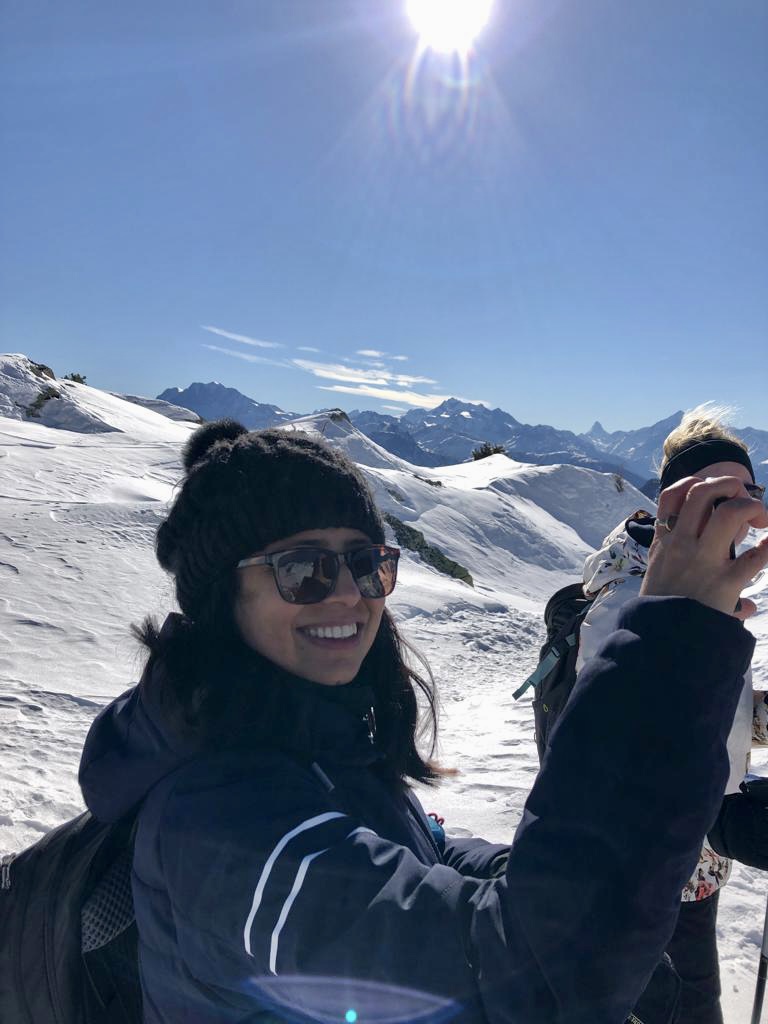
About Shelly Verma:
Shelly Verma is a storyteller and story coach based in Switzerland. She works with traditional, contemporary, and personal narratives to create stories that inspire social change, give voice to the unheard, and make the unseen noticed.Shelly has performed at a wide range of venues, including schools, libraries, clubs, Ignite Zurich, TEDx Basel, storytelling festivals, and even in the woods and cemeteries at night-enthralling both children and adults with her stories.
She loves mythology and folklore from around the world, and her recent work has focused on creating digital storytelling documentaries around ecology, our past and present relationships with nature, and climate change for storytelling festivals across the globe.This year, she founded The Storytellers Club, a monthly evening where everyday people share true, five-minute personal stories around a chosen theme.
Shelly believes stories help us connect and relate to each other more deeply and meaningfully-and that belief lies at the very heart of what she does and why she does it.
3 Responses
Shelly, loved your blog. I remember the time. It was at Secaucus Library in New Jersey, USA last summer.
I was a with a group of intimate listeners and forgot my script and listened to stories unfolding.
看不懂但大受震撼
https://shorturl.fm/nkhaC